Monday, May 11, 2009

Mezz Mezzrow

The best works suspend disbelief just as film can. Much of that is language, the new-age types will call it "the authentic voice" in other words: to write honestly and in the language you speak. Mezz was a man who genuinely wanted to be black. He was born Jewish but was madly in love with Hot Jazz, and the people that created it played it and the culture that surrounded it. In the early 1940s he wrote a book about early jazz music, and all in the slang of the era. For him it was a life of poverty, crime, incarceration, and mad, mad love for music.

He writes pages upon pages to describe performances. I'll quote a long passage that exudes his adoration:

"He started to blow his chorus, tearing his heart out, and the tones that came vibrating out of those poor agonized lips of his sounded like a weary soul plodding down the lonesome road, the weight of the world's woe on his bent shoulders, crying for relief to all his people. He was fighting all the way, aiming to see it through and to be understood by all, right down to the last heartrending wail of his plea. All the lament and heartache of life, of the colored man's life, came throbbing out through that horn. That wasn't any horn blowing that night. It was the conscience of the whole aching world, shouting damnation at sins and evil...
...Louis began that tortuous climb up to high F, the notes all agonized and strangled, each one dripping blood. He was like the prodigal son who finally sights his home, sick and weary of a lifetime or roaming, determined to get back there before his heart stops beating. He was fighting and sweating blood all the way, and what came out of his horn sounded less like music than the terrible wild shrieking of the lost and damned...
...And then, with the last breath of life left in him, like a man in death convulsions, heaving with his heart and soul lacerated guts for the last time, Louis clutched and crawled and made that high F on his hands and knees, just barely made it, at the last nerve-slashing second. A shock and a shiver ran through the theater. The whole house shuddered, then rocked with applause. Louis stood there holding his horn and panting, his mangled lip oozing blood that he licked away, and he managed a bow and smile again, making pretty for the people."

Thursday, April 09, 2009

Lo lo, lo lo — Lomax

Alan Lomax writes a bit like a hipster. When writing about jazz it's entirely appropriate, and in 1950 possibly unavoidable. He was a jazz fan, a blues fan , a folklorist and an archivist.
"...Morton and the boys in the band tell the story their own way. Sometimes they brag; sometimes they remember exactly what was said or how things looked; sometimes they remember is the way they wished it; but somehow out of the crossing of misty memories comes truth comes a hint at great secrets how music grows how artists can be pimps when they have to be and still set the world dancing with fiery notes."
Did he say pimps?
Yes he did.

It gets better. He writes elsewhere in sleepy broken sentences expressing the pace of his own real experience. it's cleverly executed and shows he's no mere librarian. The ellipses are all his below.
". . . A gravel voice melting at the edges, not talking, but spinning out a life something close to a song . . . each sentence almost a stanza of a slow blues . . . each stanza flowing out of the last like the eddies of a big sleepy Southern river where the power hides below the quiet brown surface."

Wednesday, March 25, 2009

Go

It's called the first "Beat" novel. As a monument to that it does properly use the word "beat" and maintains a mostly plot-less narrative to youth and to that era. Holmes doesn't get the credit that Cassady, Kerouac Burroughs and Ginsberg do. Unlike many others, author John Clellon Holmes, like Kesey outlived the era. So they were able to produce later better works for which to be renowned.


"Fuck you! Fuck you! Fuck you!"
Just that snarling curse, shouted over and over again, at every-thing: the cars, the buildings, the deaf night itself; those two crude words, full of outrage and horror, thrown into the streets like crashing bottles.
"Fuck you! Fuck you! Fuck you!"
-John Clellon Holmes

Wednesday, March 18, 2009

John A. Woodworth

To me this demonstrated a masterful use of em dash, comma and semi colon to string a narrative. To write a run-on sentence is simple... to employ proper punctuation or even improper punctuation so that it makes sense is a challenge. Writing like that is a reason to subscribe.From his article Beating Scriptures from Fish in the Appalachia Journal Winter 1984:
"Chengtu is a melange of offensive odors, a din, a welter of confused discordant sounds, a clangor of traffic, a noisy, dusty, dirty place of milling pedestrians of every age and description — half-clad children with half-shaved heads playing in the street; old men with long, drooping, thin mustaches and sparse, pointed beards; young men in modern dress; old women hobbling painfully on tiny, bound feet, victims of a social custom now forbidden by government decree; men wildly running an dodging through the crowds pulling swaying rickshaws; soldiers in yellow cotton uniforms; officers carrying sabers; a rare automobile, klaxon blaring, crowding everyone off the street; geese and ducks swimming in puddles; hens pecking their way in and out of doorways; peddlers of eels holding their slimy catch aloft for a buyers critical scrutiny; bakers compounding strange pastries on tiny stoves; large, open-sided teahouses, crammed with people and humming with conversation; knots of curious bystanders watching a G.I. bargain over a souvenir, throngs of theatergoers pouring out of a puppet shadow play; policemen in black uniforms that look like crepe paper, wearing black helmets and an air of authority in the glint of their spectacles; craftsmen at their shops, metal workers, silversmiths, cabinet makers, and tailors."
-John A Woodworth

Tuesday, March 03, 2009

Jim Jarmusch

Source: Movie Maker magazine 01/22/04. He wrote it himself of course.

"Nothing is original. Steal from anywhere that resonates with inspiration or fuels your imagination. Devour old films, new films, music, books, paintings, photographs, poems, dreams, random conversations, architecture, bridges, street signs, trees, clouds, bodies of water, light and shadows. Select only things to steal from that speak directly to your soul. If you do this, your work (and theft) will be authentic. Authenticity is invaluable; originality is nonexistent. And don’t bother concealing your thievery—celebrate it if you feel like it. In any case, always remember what Jean-Luc Godard said: “It’s not where you take things from—it’s where you take them to."

-Jim Jarmusch

Thursday, February 26, 2009

New York Howl

Every band has a story an image a brand and a one-sheet. Rarely is it well written, rarely is it well-conceived or even vaguely interesting. The New York Howl however... what a great line. Who wrote it? Who knows.
"The New York Howl is an explosive punk, blues, rock n roll, psychedelic, soul family band living in Brooklyn, New York. We share a dream. We endeavor to hold the crackling, livid, blinding, screaming, fleeting, weightless truth in the palm of our hands, in the muscle of our hearts, and in the wet of our mouths. You will see us breathe bright waterfalls of fire and you will hear the sounds of children playing with electricity."

Sunday, February 22, 2009

Roth

"The profusion of stars told him unambiguously that he was doomed to die, and the thunder of the sea only yards away—and the nightmare of the blackest blackness beneath the frenzy of the water—made him want to run from the menace of oblivion in their cozy, lighted, underfurnished house."
Philip Roth is still alive, and while his book "Everyman" is in my view his best since Portnoys Complaint his persistence gives hope he will better it yet. It's been half a century since he began writing and still no one else grasps that arena of queasy emotionality. He discussed it on NPR back in 2006.

Thursday, February 12, 2009

Black Market Surgery

Matthew Good was probably fabricating everything. But he wrote an online journal of sorts. For a short period of time he was on Atlantic Records, and they for some reason printed them in two editions with identical covers but including journals of slightly different eras. the writing was disjointed, non-linear almost reflective of the Burroughs cut-up experiments. But ultimately, the words are not shuffled, only the strange mind of Mr. Good.
"Tomorrow everything will be the same as it was yesterday. Today is just another two minutes on the news. That picture in your wallet, salvation, they won't bring that up. Will they? There's a million different ways to say I love you."

Monday, February 02, 2009

Brother JT

Brother JT was a small-time rocker, a local legend that didn't make the big leap. His old band The Original Sins were a garage rock powerhouse. Today he's a more minor figure. But in his introspective obscurity he wrote a substantial rock essay. I say rock essay as you might say rock opera. It's 58 pages long and strings together his ideas about acid rock, Jesus, baseball, Ted Nugent and Miles Davis. He posted it online here.
"Her impossibly nimble, razor-like voice performs a sacred earjob on the listener, carving an explicit dream of dusty tent initiations into your poor brain, while simultaneously rubbing warm balm into the incision, leaving only a scar of involuntary enlightenment."

Tuesday, January 27, 2009

Ken Kesey

I feel unqualified to judge Kesey. When beat writing emerged from jive talk, it's literary adherents where young and up to the task of redefining literature. For all the talk of Don Quixote being the first modern novel... our present literary fiction bears much more similarity to thsi work. There were others surely, Go by John Clellon Holmes, and On the Road by Kerouac but these were biographical. Kesey tacked the other beast, the novel. in One Flew Over the Cuckoo's Nest he also took a tip from Guy de Maupassant, with a narrator who is insane.
"The worker takes the scalpel and slices up the front of old Blastic with a clean swing and the old man stops thrashing around. I expect to be sick, but there's no blood or innards falling out like I was looking to see-just a shower of rust and ashes, and now and again a peice of wire or glass."

Monday, January 19, 2009

Roman Proske

To my knowledge he wrote nothing other than his autobiography. the book is pretty bad, if his life wasn't so interesting, the book would be outright hopeless. The play-by-play is great, but the color is lacking. His observations are few, leaving the text thin. But once, he makes a strange poetic observation.
"The thought that my lions were housed in the same den that had been occupied by the lions of Rome two thousand years before, that I was treading the same ground where the spectacle of the circus had it's origins, moved me deeply. I felt a kinship with more forebears, the gladiators, so long turned to dust, who had once faced death here, and triumphed or gone under. This dry, sunbaked earth that had known the taste of blood of men and beasts was sacred to me."

The lions are no metaphor. He was a lion tamer. But when first browsing, I didn't know that. I think as much as I like it, I liked it better when the lions were a vague idea of something regal but menacing.

Sunday, December 21, 2008

The Stranger


It's hard to imagine it was made into a film. But it was Orson Welles, and it was 1946 right after the first English translation, in the middle of the red scare so maybe, at the height of our collective paranoia it may have been possible. It was published first in 1942 in French of course. In 1954 he even recorded an audio book himself. It was his true first novel, his prior work all being non-fiction. There are three primary English translations.

Stuart Gilbert (1946): Formal and stiff.
Matthew Ward (1989): More even handed and modern, my preference.
Joseph Laredo (1983): Similar to Ward but not as immediate.

"And I, too, felt ready to start life all over again. It was as if that great rush of anger had washed me clean, emptied me of hope, and, gazing up at the dark sky spangled with its signs and stars, for the first time, the first, I laid my heart open to the benign indifference of the universe. To feel it so like myself, indeed so brotherly, made me realize that I’d been happy, and that I was happy still. For all to be accomplished, for me to feel less lonely ,all that remained was to hope that on the day of my execution there should be a huge crowd of spectators and that they should greet me with howls of execration." -Camus

Saturday, December 06, 2008

The Strange Woman

Ben Ames Williams, author of short stories and novels, was born in Macon, Mississippi in 1889. Strangely his best work was set in Bangor Maine. Much of the book feels dated, but when he delves into a sefarers gothic his provse comes alive in a dark 'Billy Budd' kind of way. He repeatedly descibes a hydrophobia that I don't think has ever been matched.

1.
"He imagined the canoe overturning, felt the strangling water flood his laboring lungs, saw his body sinking with last spasmodic reflex jerkings of arms and legs to rest at last on the dark, slimed bottom of the lake till great sluggish fish with toothless mouths came to pluck at the soft, decaying flesh."

2.
"...and he imagined the canoe broken against these ledges and saw his own helpless body caught by the current and whirled downstream, to smash against the toothed rocks with sodden. bruising blows, and he imagined the egglike crunch of a cracked skull or the hideous grating grind of breaking bones in his arms and legs. "
The paranoid fears of course were skilled foreshadowing for the real incident

Monday, December 01, 2008

...

Sunday, November 30, 2008

The Wine of San Lorenzo

"The vast crescent backdrop of mountains began to merge into the darkening sky and a few stars glowed faintly through the incredibly clean air. It was both day and night, an overlapping of both, that infinite moment in the twenty-four hours that Juan Diego loved best..." -Herbert Gorman

Much of the book is downright cheesy actually using the terms "villainous" and "savage men" as a writer only could in 1945. But his flourish works well for certain applications. Mine is a used copy of course.

Thursday, November 27, 2008

The Forest People

Really an anthropological text, The Forest people tells the story of living among the pygmy to tell the story of the pygmy. On some levels it fails. Writer/anthropologist Colin Turnbull changes the turn of events by being there. His writing gets a tad nostalgic and even misty when he describes how amazed he is by the pygmy. He's more of an active player than is probably appropriate. But he does have some truly great insights. But the two sides are somewhat at odds. (capitalization and italics are his)
"I heard him Murmur once more "You will see things you have never seen before... You will understand why we are called People of the Forest... When the Forest dies, we die." And for the last time I heard the chorus of that great song of praise: "If Darkness is, Darkness is Good."
I have no recourse but to beleive that is is as he describes, but so much of the rest of the book reads less fantastically. It's minimalism is so much more effective when used to express the stunning newness.
"The Pygmies express various degrees of illness by saying that someone is hot with fever, ill, dead, completely or absolutely dead, and, finally, dead for ever."

Tuesday, November 25, 2008

off topic.


I scanned a DIY comic I bought 15 years ago. Thought I'd share. The artwork is deliberately low-brow, but the plot line is disturbed.
http://www.divshare.com/download/5926089-1c3

Sunday, November 16, 2008

L.S.D.-25

A modern Kerouac, a 255 page narrative on youth, rebellion, misery and of course drugs. It's a bit of a cult classic. Good luck finding it.
"I'd hoped that I would taste something strange - all this talk of synesthesia - but the turkey was just turkey.I was still me, neither happier nor more depressed, and, aside from a bit of vertigo, the world was still the world." - Jess Yandow

Thursday, October 16, 2008

Robert Herrick

From the book The Web of Life, by Robert Herrick first printed in 1900. He was an early American realist, and one really engaged with all the Gothic trappings of our then fresh industrialization. He's the American answer to George Gissing. Of his 13 books this is generally considered by critics to be his best. Due to the wonderment of public domain you can download it free if you can find it. It was on Google Books, but has been mysteriously withdrawn.
"Thus the body social threw out much smoke, but no vital heat; here and there, the red glare of violence burst up through the dust of words and the insufferable cant of the world."

Saturday, September 27, 2008

Jorge Luis Borges

Jorge Luis Borges describes the meeting of deserter martin Fierro and Tadeo Isidoro Cruz. None of us may ever write a sentence this powerful in our lives.
"Any destiny at all, however long and complicated, in reality consists of a single moment: the moment in which a man once and for all knows who he is."

Thursday, September 04, 2008

Carlos Fuentes: The Old Gringo

A normal run-on sentence is pedestrian. The forceful, marauding use of polysyndeton to drag out a sentence into a multiple page narrative is badass. The comma, the semi colon, the parentheses, and the em dash all feature. Carlos Fuentes wrote in Spanish, as his native language. In translation, his grammar and punctuation was preserved as much as possible. It leaves me to wonder if this one sentence was even longer and more ungainly in the original.


"I could breathe with the place and see what each one was doing in his own bedroom, in his bathroom, in the dining room, there as nothing either secret or public for me the little witness, Harriett, I who saw them all, heard them all, imagined and smelled them all by simply breathing with the rhythm they didn't posses because they didn't' need it, they took it all for granted, I had to breathe in the hacienda, fill my lungs with its smallest flake of paint, and be the absent witness to every single copulation, hurried or languorous, imaginative or boring, whining or proud, tender or cold, to every single defecation, thick or watery, green or red, smooth or caked with undigested corn, I heard every fart, do you hear, every belch, every spit fall, every pee run, and I saw the scrawny turkeys having their necks twisted, the oxen emasculated, the goats eviscerated, and put on the spit, I saw bottles being corked full of uneasy wine of the Coahuila Valleys, so near to the desert that they taste like cactus wine, then the medicine bottles being uncorked for the castor oil purges, and the fevers running high in death and childbirth and children's diseases, I could touch the red velvets and creamy organdies and green taffetas of the hoopskirts and bonnets of the ladies, the long lace nightgowns with the Sacred Heart of Jesus embroidered in front of their cunts: the quivering, humble devotion to the votive lamps quietly sweating away their orange-colored wax as if caught up in a holy orgasm; contrasting, gringa, with the chandeliers of the vast mansion of stylish, expensive wooden floors and heavy draperies and golden tassels and grandfather clocks and wingtip chairs and rickety dining room chairs bathed in golden paint-I saw it all, and then one day my old friend, the most ancient man in the hacienda, a man maybe as old as the hacienda itself, a man who had never worn shoes and did not make noise (Graciano his name was, now I recall it), dressed in white peasant shirt and pants, a piece of rawhide that man, wearing clothes patched over and over again will it was impossible to distinguish between the patches on his clothes and the wrinkles on his skin, as if the body had also been patched over a thousand times: Graciano with his white stubble on his head and chin was the old man charged with winding the clocks every evening, and one night he took me with him."

Try to top that.

Monday, August 18, 2008

Annie Dillard

Annie Dillard is overtly spiritual making most of her books degenerate into insane glossolalia-worthy gibberish. She connects utterly unrelated thing son the way to not ever making a point. But the stories are interesting if you don't mind skipping the pages of drivel. But in that jumble of deeply heartfelt dookie, are some wonderful turns of phrase. My example, For the Time Being Knopf books circa 1999.

"Later, if the boy saw a book left open on a bench, he spreads a prayer shawl to cover its open pages. In his world, people respected books. When a book wore out, they buried it like a person."

These two sentences make a cult of this boys thinking. The outside world disrespects books, possibly property, It symbolizes a disrespect for language, knowledge and maybe even the boy. Most importantly it isolates him and also gives him a ghostly seeming presence. It's very intriguing. If only she could carry a plot.

Thursday, August 14, 2008

cockpunch

" ...the Russian operation in Georgia was straight out of Col. Boyd's playbook: Roll in hard and fast with overwhelming force, administer the cockpunch, and be finished before anyone can prepare a response or start blathering on about peackeepers and/or UN resolutions. Because that's how it's done in the New Century of the Naked Ape."
-S.A.W. (courtesy of Strudel and Shotguns)

This was an incredible turn of phrase. The juxtaposition of the formal word "administer" a verbose synonym for "apply" or "do" and the very informal, perhaps vulgar "cockpunch." It reminds me of the TV series Deadwood. Deadwood and it's own turns of phrase that won David Milch such laurels. For example:
"I may have fucked my life up flatter'n hammered shit, but I stand before you today beholden to no human cocksucker."
It's a rare writer that can do thsi with fluidity and still carry a plot, a dialog or a message. Strudel & Shotguns manages all three.

Saturday, August 02, 2008

Breece D'J Pancake

It's probably one of the best books I ever read. His sentences are short like Hemingway but they stack up better somehow. The voices are truer, and the locale grittier and more tangible. It lacks the 1950s maudlin quality that Hem couldn't help painting all over France, Cuba and Africa.
"I should never show up in these little river towns until my tug comes in - but I always come early, wait, watch people on the street. Out there vapor lamps flicker violet, bounce their light up from the pavement, twist everything's color. A few people walk along in the drizzle, but they don't stop to look into cheap shop windows."
There is a collection of his short stories available. His catalog is short. In 1979 at the age of 26 he shot himself in the head.

http://www.theatlantic.com/doc/200404u/pancake
http://www.appalachianbooks.com/Authors/Breece%20Pancake.htm
http://www.npr.org/templates/story/story.php?storyId=1151208

Tuesday, July 22, 2008

Linda Yablonsky

Linda Yablonsky is a music critic. She's not quite on par with me, but she's much more suave and that's worth something. She also used to be on Smack and you can't beat that real-life experience in writing. Her book "The Story of Junk" is a strangely detached tale of a drug-fiend. While some may recoil at the inhumanity. Sincerity cannot be overrated. I quote a single sentence from a concert review she wrote in another less graphic book: The Show I'll Never Forget.
"I remember Roach go at his drums as if they were the pages of a book of joy and madness that he was reading and writing at the same time, that Simone picked up to add color and meaning."
You had me at "Joy and madness."

Wednesday, July 16, 2008

DONALD G. McNEIL Jr.

Most newspaper writing today is disposable, it's of less substance than magazines or (gasp) blogging. But like any broad encompassing statement, there are exceptions. I found this recently and stopped to re-read the paragraph. It's self-aware like meta text and reads like a narrative magazine article. I am surprised most of all, to find it in the New York Times. Here.

"Ten years ago, I stood in a clearing in the Cameroonian jungle, asking a hunter to hold up for my camera half the baby gorilla he had split and butterflied for smoking. My distress — partly faked, since I was also feeling triumphant, having come this far hoping to find exactly such a scene — struck him as funny. “A gorilla is still meat,” said my guide, a former gorilla hunter himself. “It has no soul.” So he agrees with Spain’s bishops. But it was an interesting observation for a West African to make. He looked much like the guy on the famous engraving adopted as a coat of arms by British abolitionists: a slave in shackles, kneeling to either beg or pray. Below it the motto: Am I Not a Man, and a Brother?"

Thursday, July 10, 2008

Billy Ray's Farm

The language is deceptively simple. He only branches off into the wow and flutter in a very measured way. I really like the way he does it. Sometimes it's just country language. It's not real country language, it's shit he made up, like referring to a bulls genitalia as a "calf-maker." It adds color but not at the expense of the tale. I'm going to quote the book twice here to show two other ways he goes about that business.
"I could imagine stinking heaps of bream and carp, maybe bulletheaded behemoths in torn T-shirts standing in them, bloodied, with fishbillies in their hands, the weeps and near-orgasmical moans of grandmaw in a cotton housedress, a big buffalo lodged and wiggling dumbly between her thighs, others wading for help, clubs raised. I could smell the blood and death of it, could see how the sun woudl be shining down on the carnage at nine o' clock in the morning."
The first part is so exaggerated and comical then in the last sentence so Gothic and abrupt. It just ends the run away idea so it can end at all. Here he does the same thing but the feel is comic instead of stark. The grammar is deliberately broken moving the continuity from feeling of a character in control, who has a plan.. then exhibiting doubt, but also awareness of his own folly.
"I approached him slowly, speaking calm words of encouragement. There was a wire gap somewhere along the fence, and it I could just get it open and somehow get behind him without spooking him it might be possible to herd him gently back toward where he belonged, without getting too close to him. I be a man who be afraid of his own bull."

Monday, June 16, 2008

The Power and the Glory


It's hard to imagine that in 1940 this book was controversial, but it was. Catholics condemned the book. Evelyn Waugh and others defended it. Mr. Greene ended up meeting with the pope who told him the book was offensive to Catholics. The popester took 14 years to get around to condemning it. They are a delicate and sensitive bunch who need to get out more. The book is in my opinion some of his best work. He was bipolar and you can tell.
"The buzzard came picking its way across the yard, a dusty and desolate figure: every now and then it lifted sluggishly from the earth and flapped down twenty yards on."
-Graham Greene

Thursday, June 12, 2008

These People Are Us

George Singleton write conversationally, fluidly like real life. He writes like the monologue that narrates our memories, simply and without undue adornment. It emphasizes the singular occasions when he gets artful. It leaves his works relying mostly on players and plot.

He said in an interview once that "I am my main characters, for better or worse." Their faults are his faults, their virtues (if there are any) are also his.
"I'd look down at the lake and wonder why our bodies seemed more water then dirt, more dirt than air or fire."
-George Singleton

Saturday, May 24, 2008

Rene Maran is Batouala

Batouala was first published in 1921. Rene Maran, while born in Martinique he moved to Gabon in Central Africa when he was 7. It's the setting for his book Batouala. It was written in French of course, my translation was printed in 1930 from a 1922 translation by Thomas Szold Seltzer. The text is now in the public domain. While my copy was $2, your can be free here.

As with all translations I assume that the story line is the work of the writer, but the language that of the translator. As with all my assumptions it is probably only part right. the language is overt and flowery and almost Victorian.
"Gradually colors faded, from shade to shade, from transparence to finer transparence, and the beams in the immense sky scattered. the last shades of color were blotted out. The indefinable silence that watched over the agony and the death of the sun spread over the whole earth."

Thursday, May 08, 2008

Jean Thomas

Jean Thomas was a charlatan, but her reverence for mountain music lend a certain tone to her writing about the gene that was unique to her. Problematic in her work is separating real words from what she fabricated. It is said that often she just made up crap. It's a shame as well, her own writing is staunch and vivid. There's no reason for her to be attributing false words to non-existent people.
"He lay there in this fix, cold as a rock for some time. He were laid out for dead. And after a long spell he were revived up with this song on his lips"
This was followed by the tablature for a traditional rendering of "O'Death"
More here.

Friday, April 18, 2008

John Muir

John Muir was kind of a hippie botanist, and also a racist which was pretty much standard fare in the late 1800s. He walked from Kentucky to Florida. His writing was somewhat Victorian in it's overt flowery form. But he was somewhat different than his contemporaries as he was a botanist first, and a writer second. Actually he had enough other hobbies that writing was somewhere trailing long behind.
"Of death among our own species, to say nothing of the thousand styles and modes of murder, our best memories, even among happy deaths, yield groans and tears, mingled with morbid exultation; burian companies, black in cloth and countenance, and, last of all, a black box burial in an oll-omened place, haunted by imaginary glooms and ghosts of every degree. thus death becomes fearful, and the most notable and incredible thing heard around a death-bed is , "I fear not to die."

Sunday, March 09, 2008

nada y pues nada

Repetition is a difficult tool to use. It's well-explored in poetry and in song, but in prose it's difficult to apply. Here's a fine instance.

Here's a passage from the short story A Clean Well-Lighted Place.
"Some lived in it and never felt it but he knew it was nada, y pues nada y nada y pues nada. Our nada who art in nada, nada be thy name thy kingdom nada thy will be nada in nada, nada as it is in nada. Give us this nada our daily nada and nada us our nada as we nada our nadas and nada us not into nada but deliver us from nada; pues nada. Hail nothing full of nothing, nothing it with thee. "
Interchanging the Spanish and English tells you thing about the character as does the use of the lords prayer and it's mildly sacrilegious modification. Without revealing anything about the story, you know things about the character.

Friday, February 29, 2008

The Johnstown Flood

It's been continuously in print since 1968. Mine is an original hardback. Author David McCullough has a mixed catalog. But something about the tragedy of Johnstown brought out his better qualities. His movement between cold hard facts, and first hand accounts mixes seamlessly with his smooth but dark prose.
"The cold was nearly as cruel as it had been the night before. Pitch-blackness closed down over the mountainsides that crowded so close; but across the velley floor bonfires blazed, torches moved among the dark ruins, and the rivers and big pools of dead water were lighted by the fire that raged on at the stone bridge."
It’s all on Google books of course

Wednesday, February 13, 2008

Wayne Ude

Wayne wrote the book Becoming Coyote in 1981. In the middle of a cultural punk movement in music and literature he delved into American Indian culture. In the book he literally and figuratively takes the title into the text.
"For years I'd walked suspiciously around the idea, sniffing at it, kicking my leg up occasionally and pissing on it so I'd be able to find it again, then wandering away for a while knowing that the piss smell would help me identify it when I came back. Now I was ready to accept the idea, to piss on it not just so I could find it again, but to mark it as mine, within my boundaries."
He totally contorts, reshapes and abuses the metaphor in every way possible. It's really a very strong passage in a totally underrated book.

Saturday, February 09, 2008

Max White

It was printed in 1946, after his well-received novel "Tiger -Tiger." The Book "In the Blazing Light" was about the life of the artist Goya. While unauthorized biographies of today exist to tarnish, or propagandize, at the time this book of drunken debauchery and violence was somewhat unique. Time Magazine wrote a telling review here. The title is taken from a quote on the title page:
"This was the conduct of a man who feared nothing, not even death. He, whose eyes were getting dimmer, lived constantly in the blazing light of his own genius."
Blazing light is not an entirely unique term. But using it zoomorphicly is odd. Even more oddly he may have stolen it from Sir William Jones in an article written about British Lawyers in 1830. It's in the public domain and can be downloaded here.
"His studies were so various, yet so deep; his knowledge so universal, yet so profound, and his abilities so extraordinary, yet so unlimited, that nothing that the human mind had compassed, however deep and metaphysical its researches had been, whether employed in developing the hidden principles of matter, or of disclosing the secret laws of nature, or of searching into the deep and mysterious truths of philosophy; nothing, however infinite and vast; nothing, however subtle and obscure, but he threw upon it the blazing light of his own genius, or grasped it in the powerful embrace of his gigantic intellect."

Sunday, January 27, 2008

Friday, January 18, 2008

Mort Rosenblum

Mort Rosenblum published his book "Olives - Live of a noble fruit" in 1996. It's largely autobiographical, injects all too much politics and really just strings together a long essay on olives with numerous quotations, bland poetry and a few decent recipes. But the portions in first person, as real as they appear to be the dialog seem to be exaggerated. They're just too consistently good to be true to life. For example, he visits a series of olive groves, and olive oil makers. This exchange with Juanito appears in Chapter 5.

"Never measure," he said. "you must never measure. Splash. Pinch. Use your eyes, your instinct. Never spare the oil." What did he think about butter people? "Tontos." he replied. "Fools."
When we got up to leave, finally, I asked Juanito, "Are you sure you never cook anything in butter?"
"Feh," he spat. "Poison."

Friday, December 28, 2007

Favorite books

I limited myself to books I've read more than once. I think that proves their mettle. Each description is followed by the number of times I've read it.

"Oranges" by john McPhee You might think it's dull. It's about early Florida Orange growers, but that slice of culture was totally unknown to me and very endearing. 2

"Where Strange Roads go Down" by Mary Del Villar about 2 beatniks walking across rural Mexico. 2

"Where Rivers Ran Backward" by William E. Merrit was also great. Another Vietnam biopic, I liked his continual interspersing of rock lyrics to lock the story to the era. 3

"The Devil and Sonny Liston" by Nick Tosches which many would find crude and borderline offensive. It's the biography of the baddest man who ever lived, who happened to be a famous boxer. 5

Stephen King: "The Dark Tower" say what you will. He wrote it at the height of his drug-induced mania. It's brilliant. I think it stands alone as the rest of the series is strictly downhill. 3

Jim goad wrote a book called "the Redneck Manifesto" that was patently profane and indecent and borderline obscene. Alternately it was some of the most original and thought provoking literature I've ever read. 2

Russell Hoban writes books that are hard to follow, difficult to read and often totally unsatisfying to finish. But his use of language is a weapon. He invents new words, sometimes whole new languages. Each book of his I've read is it's own struggle to finish and comprehend. "Riddley walker" is about post apocalyptic future written in a devolved English language replete with new words, new grammar and new spellings. His book "Klienzeit" is even harder to follow and a long narrative that I think supposes existentialism is wrong and metaphysics are right and nothing
is real. Or it's just absurd. I don't think I understand it. 2

"The Crossing" Cormac McCarthy, He is unstoppable in all his gothic western glory. 2

Hunter S. Thompson..It's hard to limit myself to one book... I own most of them, but "Fear and Loathing on the Campaign trail of 72'" is a tad better than the classic "Fear and Loathing in Las Vegas." 2 (each)

Saturday, December 15, 2007

Simon Winchester

I like to read non-fiction. It's an easy read, you educate yourself and there's no tension in stopping mid-sentence at bedtime. John McPhee, Mark Kurlansy, and Simon Winchester all figure prominently in the personal library.

Simon Winchester's most recent work "A Crack in the Edge of the World" ruined it. He has a new and unnatural urge to dip deeply into the thesaurus. (The origami book jackets remain a fixture.) Below is a complete list of the world I had to stop and look up. many were technical terms a geologist would know, some were typos but most wee just him being difficult. (I've excluded those technical terms he included in the appendix.)


umbos
terminator line
ailanthus
orogeny
febrile
annus mirabilis
skein
kittieakes
fulmars
post hoc ergo propter hoc
auguries
gasconading
lickspittle
panjandrum
hobbledehoy
sauve qui peut
lumpenproletariat
quotidian
archdruidical
ultramafics
minié
cordilleran
allotropes
coesite
sishtovite
niggle
E pur si muove
mountain cwn (might be a typo)
sunder
long chalk (British idiom)
plashes (typo)
friable
serried
soda lakes
bathyscapes
nosegay
inapposite
tisanes
saturnalia
skerries
quayside
louche
melodeons
sartorial
laager
magisterial
penuriousness
cuboids
brocade
capo di tutti capi
sylph-waisted
Liebfraumilch
phaetons
hansoms
cupola
chance medley (British idiom)
porte cochere
whiffletree
pilaster
phylloxera
asperities
nullahs
rills
caryatids
galangal
pour memorie
xenolalia
jeremiad
maunderings
périphériques
quotidian
hectopascals

And of course the quote:
"The locals are seemingly obsessed with constant stories of death (as fishermen drowning in sudden storms, birds perishing in their hundreds of thousands, beaches made exclusively from the crushed bones of fish skeletons, various species of flora and fauna dyning out as the level of salinity, which is already close to that of the pacific ocean keeps on climbing in the hot and pitiless sunshine)."

Monday, November 26, 2007

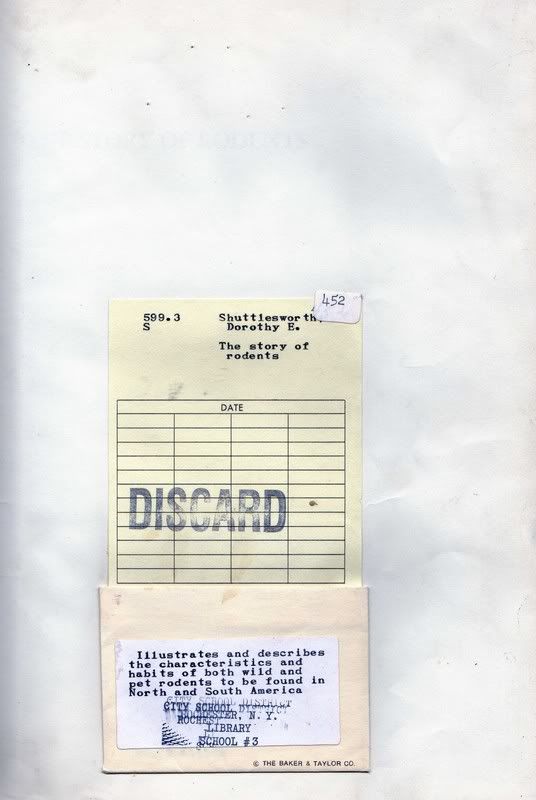
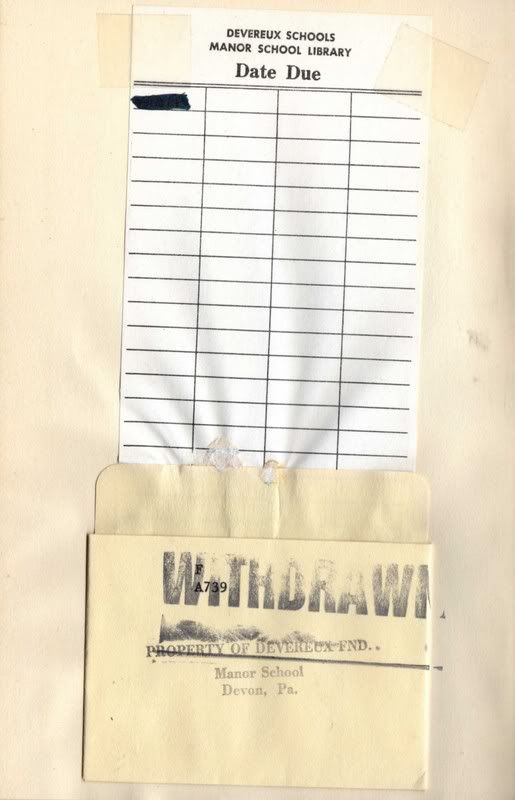
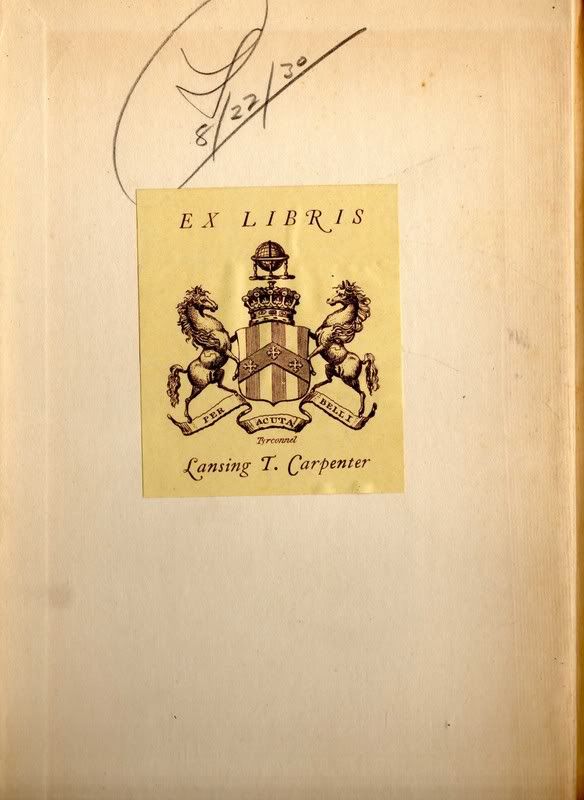
Library Discards

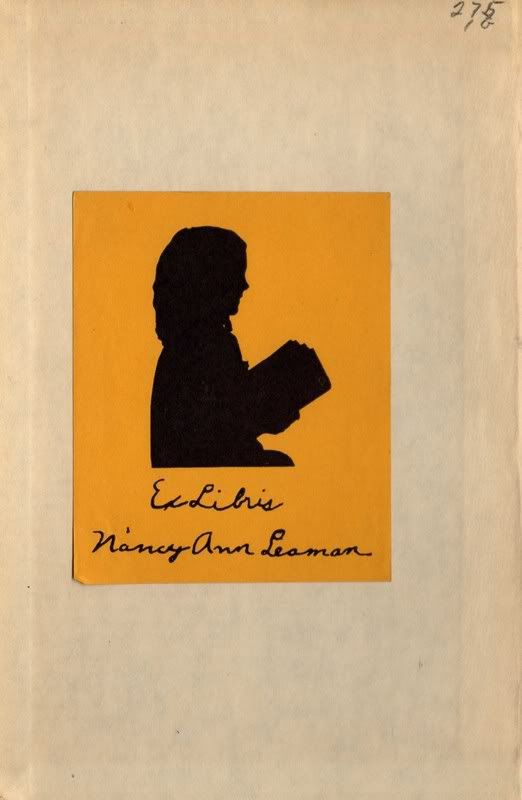
Often the marking of a good book, and a tired one. I was surprised upon looking how few of my books were marked ex libris. Then I noticed how many were missing one of the the end papers. Libraries discard resellers cut off the marked pages to create the appearance of a less used book. What a shame. I'd prefer to know where it's been.


Wednesday, November 07, 2007

Darker Blues

I'm quoting a quote, but they re-use the passage masterfully in a meaningful place. The book is a collection of biographical essays about the musicians of the northern Mississippi. And in context the place matters as much as the people.

"On the fields, in the forests, in the streets and yards and homes and businesses, and barns, the water left a rising muck. It filled the air with stench, and in the sun it lay baking, and cracking like broken pottery, dung-colored and unvarying to the horizon..."

-Originally from Rising Tide, by John Barry.

Saturday, October 27, 2007

By Grand Central Station I Sat Down and Wept

Elizabeth Smart wrote the most overtly dramatic book I've ever read, and most of it for all of it's bloated melodrama was also a work of evocative poetic-prose. The book is epic. Most of it is senseless out of context. But the book was autobiographical, and like real life, had a sequel: The assumption of the Rogues and Rascals. They're often sold bound together as they pertain to the same characters and plot lines of the authors life.

"Once upon a time there was a woman who was just like all women. And she married a man who was just like all men. And they had children who were just like all children. And it rained all day."

You can smell the dissatisfaction. After By Grand Central Station I Sat Down and Wept, it's as if she learned craft to companion the intensity of her expression. Much of the book is still burdened with extreme melodrama, but the prose is still in it's own league. I'll quopte a tad more:

"Sometimes with slow understanding they make imperceptible movement towards each other, perectly balanced on their twig; their eyes outward, their snouts upwards, their tails curled permanently like teacup handles."

Sunday, September 30, 2007

Smokestack Lightning

The book Smokestack Lightning is about barbecue and the gnarled fingers of elderly black men smoking cow heads and brisket in hand-dug smoke pits in the yards behind abandoned gas stations in the South. More than that of course... It is not a cookbook it's as much about the American Dream as Fear & Loathing was. The concepts are surprisingly vast in a biopic that's more often a comic foil in the middle of a morning tv show. Lolis Eric Elie makes it all artful, tangible and powerful. It courts the real for the greater sense of palpation.

"Truth being what it is-vast and yet surprisingly deceptive-what you will retain will be the tale's edited version, it's essence. And as you choose to remember then, both tale and teller, Charlie mac will become more than a historian of a small village in Georgia. He will become the griot of this whole thing-its Homer if you will."
-Lolis Eric Elie

There's a great interview with the author here. I also hear his book cornbread nation is excellent but I've not read it yet. Lolis Eric Elie is a columnist and food writer for the New Orleans Times-Picayune.

Monday, September 24, 2007

Personification

The book Kleinzeit, by Russell Hoban is not very readable, and is far inferior to his more faous book Ridley Walker. But it has more personification than I've seen any any other text. Buildings are live, colors, god and death are both living breathing and seemingly mortal characters... yet he describes them so aptly in their "human" trappings.

last paragraph chapter 8:
"Hospital said nothing, had no quips and cranks and wanton wiles. Hispital huge, bigger than any sky, grey-faced, stony faced in the rough clothes of the prison, the madhouse, Tom o'Bedlam. hospital waiting, treading its bedlam round in thick boots. Hospital mute, gigantic, with thick empty hands."

Saturday, September 08, 2007

Oswald de Andrade

I cut out the paragraph and stuck it in my pocket. I found it today, years later in a book. I remembered I read it on a plane and assumed it was an in-flight magazine. I was wrong. It was Wired. The article was by Julian Dibbell, but she's quoting the modernist Brazilian poet Oswald de Andrade.


"In 1556, not long after the Portuguese first set foot in Brazil, the Bishop Pero Fernandes Sardinha was shipwrecked on its shores and set about introducing the gospel of Christ to the native "heathens." The locals, impressed with the glorious civilization the bishop represented and eager to absorb it in its totality, promptly ate him. Thus was born Brazilian culture."
-Oswald de Andrade


Full text Here.

Monday, September 03, 2007

James Parker, Boston Phoenix

James Parker is writer for the Boston Phoenix and is clearly wasting his skills on a weekly periodical instead of somthing more timeless like a book. The strong language, and the broad vocabulary, both say Nick Tosches but the brute masculinity and the heavy use of punctuation says Fulkner. Truly a surprise find last week.

"In ethnographic terms, the bouncer is the big daddy of the liminal realm, the place of thresholds, through which participants in the rite are conducted—moved along, if you like—as they pass from one state to another. Jittery clubbers at the door, agitating for entry; the gyre of and out-of-control pit, slewing toward carnage; a drugged or boozed patron sprouting invisible tusks of hostility; the bouncer is there, filling the space negotiating the transition."
-Bouncer Lit

Love the combination of words: Ethnographic, Liminal and Big Daddy in the same sentence. Gyre, slewing and "tusks of hostility" all need a good dictionary and together manufacture a dense and powerful image. Somone give the man a book deal please.

His articles here: http://thephoenix.com/Author.aspx?name=JAMES%20PARKER

Saturday, August 11, 2007

Letter from Iceland

I've always liked that Mark Kurlansky like to frequenty quote the fine language of those great writers that preceeded him.

"The towns peter out into flat rusty-brown lava fields, scattered shacks surrounded by wire fencing, stockfish drying on washing-lines and a few white hens."

From Letters from Iceland by W.H. Auden & Louis MacNeice, 1967
more recently quoted by Kurlansy in the book "Cod."

Thursday, July 26, 2007

Mark Kurlansky

In writing non-fiction the writer is limited. If you are too vivid and lively you risk the presentation of fiction. A good non-fiction writer skirts it and engages in artful language only sparingly and perferably late in the book after trust is earned.

This is part of his description of the former Fulton Street market in Manhattan circa 1860 or so.

"The gas lighting was dim and the air often misty from the river and this gave an eerie smudgy haziness to the busy market where deer and squirrels and opossums and wild turkeys were hanging from beams."
-From The Big Oyster

Saturday, July 21, 2007

Henry Miller

Not a novel pick, it is and he are classics after all. From Black Spring:

"In fact, neither of them was ashamed of showing hsi tears, something which seems to have gone out of the world now."

Monday, July 02, 2007

Hollis Gillespie

It's not the main character, because it is herself. It's not the content, she gets cute, and sappy a littel too often. The pace is conversational like that really funny friend you had in college. But peppered throughout are single sentences that are unforgetable. One that presses you to read on. from Bleachy haired honky bitch.

"Nothing like stumbling over a dead puppy to dick up your day, so thank god that didn't happen, but it almost did."

"I dislike being bled on."

"My friend is fucking her boss, which I think is a really bad buisness move."

"the eye-catching result was that they both sported big shiny red baboon asses."

Wednesday, June 27, 2007

Bringing out the Dead

Now a major motion picture if you hadn't heard. I perfer the book of course, but the movie was entertaining and quoted from the book directly for the most part. Joe Connelly isn't a flowerly writer. His meaning is compressed like Hemmingway somwhat.

"We rushed the dead boy into the emergency room."

The sentence ends a chapter and tells us the outcome without walking us through the scenes, compressing pages into the single adjective "dead." if he was just a boy, the outcome would be uncertain and require more naration. But they rushed the dead boy, that tells us more about them than the boy or the future.

Sunday, June 10, 2007

The Coma

"The Pavement, marked with grease and rain and chewing gum. thousands of peices of discarded chewing gum, pressed flat by pedestrians into a constellation. And if I reaches down to touch the paement, I could feel grit beneath my fingers. the grit stuck to the natural oils on my hand. If I lifted my hand and looked at the grit, I could see that like grubby snowflakes each grain was different from the others. Detail. Spectacular. Fractal. "

Alex Garland writes about a dream world experienced by a patient in a coma. the dream-like descriptions are all in first person and even his use of verb tense adds to the surreal feeling of the book. As a whole, the book fails probably for lack of density. It's more of a novella. Nonetheless, certain passages are gripping and totally original.

Friday, May 25, 2007

Bordertown

The book is titled "Bordertown" and regards sympathetically for the way los tejanos have been marginalized in the borderlands. It's an artbook, relying on design, montage and photographs to convey their rhetoric. But as well respected it is visually, there is come clever use of language as well. They set the tone for the rest of the book, not with the opening paragraph, but with a hand written blurb on the second. It clearly declares their book notjust as art, but also as ethos propaganda.
Yo Tengo un pistole
Con manago de marfil
para matar todos los gringos
Qui viennen por ferrocarril!
(I have a pistol
With a marbel handle
With which to kill all the Americans
Who come by railroad)
-Folk tune popular in Chihuahua durring the
Mexican revolution
and the Mexican american war.

Thursday, May 10, 2007

HYPNEROTOMACHIA POLIPHILI

Never was there a more dense, multi-faceted tome. Every sentence, capitalization, indentation, and alliteration has secondary and tertiary meanings. The author, still unknown for certain was a cryptomaniac. Even the illustrations contain coded messages.

It was printed in about the year 1500 in a language created by its author using italian grammar with words from latin, tuscan and greek. Translation of the book into english was not even attempted until 1952, but not completed uuntil 1999. Translator Prof. Joscelyn Godwin of Colgate U. did his best to hold the original authors neologisms. The result is gorgeous but also nearly unreadable.

"In this horrid and cuspidinous littoral and most miserable site of the algent and fetorific lake stood daevious Tisiphone, efferal and cruel with her vaparine capillament, her meschine and miserable soul, implacably furibund."

The original pseudo tuscan texts are here:
http://mitpress.mit.edu/e-books/HP/hyp000.htm

Saturday, April 14, 2007

Béla Tarr's minutes and seconds

"...I despise stories, as they mislead people into believing that something has happened. In fact, nothing really happens as we flee from one condition to another. Because today there are only states of being - all stories have become obsolete and cliched, and have resolved themselves. All that remains is time. This is probably the only thing that's still genuine - time itself: the years, days hours, minutes and seconds." -Béla Tarr

As quoted in Cineville http://mr-lucky.blogspot.com/

Friday, April 13, 2007

details accumulate

Todd Ashley, singer lyrcist, bassist and now blogger.:

"The details accumulate; the information wells up as the city closes in around me. But at first it doesn’t compute; it reads as gibberish, resembles chaos: a maelstrom of dust and smoke, garbage and construction debris, vehicles and animals and people and sewage, music and shouting and confusion."

http://postcards.blogs.com/

Saturday, April 07, 2007

Pierre Boulle

Pierre Boulle wrote Bridge over the River Kwai, a book that later became a classic movie. The novel, originally in French was well-translated by Xan Fielding in 1958. It contains two spectacular bricks of language, neither of which made the movie in the inevitable exanguination that has to happen to an epic novel to make it into a 2 hour movie.

The first I print here as it appears in my 1961 time edition .. bowdlerized! The two quotes appear at nearly opposite ends of the book and really show the range of the writer and the story.

"The f---ing bridge still isn't built. the f---ing Emperors f---ing railway still hasn't got across the f---ing river in this f---ing country. The f---ing C.O.; he knows what he's talking about. If you see him, tell him we're all for him. The f---ing baboon hasn't heard the last of the f---ing British army."

"All that remained now was what the Colonel called the trimmings, which would give the construction that finished look in which the practiced eye can at once recognize, in no matter what part of the world, the craftsmanship of the European and the Anglo-Saxon sense of perfection."