Monday, June 16, 2008

The Power and the Glory


It's hard to imagine that in 1940 this book was controversial, but it was. Catholics condemned the book. Evelyn Waugh and others defended it. Mr. Greene ended up meeting with the pope who told him the book was offensive to Catholics. The popester took 14 years to get around to condemning it. They are a delicate and sensitive bunch who need to get out more. The book is in my opinion some of his best work. He was bipolar and you can tell.
"The buzzard came picking its way across the yard, a dusty and desolate figure: every now and then it lifted sluggishly from the earth and flapped down twenty yards on."
-Graham Greene

Thursday, June 12, 2008

These People Are Us

George Singleton write conversationally, fluidly like real life. He writes like the monologue that narrates our memories, simply and without undue adornment. It emphasizes the singular occasions when he gets artful. It leaves his works relying mostly on players and plot.

He said in an interview once that "I am my main characters, for better or worse." Their faults are his faults, their virtues (if there are any) are also his.
"I'd look down at the lake and wonder why our bodies seemed more water then dirt, more dirt than air or fire."
-George Singleton

Saturday, May 24, 2008

Rene Maran is Batouala

Batouala was first published in 1921. Rene Maran, while born in Martinique he moved to Gabon in Central Africa when he was 7. It's the setting for his book Batouala. It was written in French of course, my translation was printed in 1930 from a 1922 translation by Thomas Szold Seltzer. The text is now in the public domain. While my copy was $2, your can be free here.

As with all translations I assume that the story line is the work of the writer, but the language that of the translator. As with all my assumptions it is probably only part right. the language is overt and flowery and almost Victorian.
"Gradually colors faded, from shade to shade, from transparence to finer transparence, and the beams in the immense sky scattered. the last shades of color were blotted out. The indefinable silence that watched over the agony and the death of the sun spread over the whole earth."

Thursday, May 08, 2008

Jean Thomas

Jean Thomas was a charlatan, but her reverence for mountain music lend a certain tone to her writing about the gene that was unique to her. Problematic in her work is separating real words from what she fabricated. It is said that often she just made up crap. It's a shame as well, her own writing is staunch and vivid. There's no reason for her to be attributing false words to non-existent people.
"He lay there in this fix, cold as a rock for some time. He were laid out for dead. And after a long spell he were revived up with this song on his lips"
This was followed by the tablature for a traditional rendering of "O'Death"
More here.

Friday, April 18, 2008

John Muir

John Muir was kind of a hippie botanist, and also a racist which was pretty much standard fare in the late 1800s. He walked from Kentucky to Florida. His writing was somewhat Victorian in it's overt flowery form. But he was somewhat different than his contemporaries as he was a botanist first, and a writer second. Actually he had enough other hobbies that writing was somewhere trailing long behind.
"Of death among our own species, to say nothing of the thousand styles and modes of murder, our best memories, even among happy deaths, yield groans and tears, mingled with morbid exultation; burian companies, black in cloth and countenance, and, last of all, a black box burial in an oll-omened place, haunted by imaginary glooms and ghosts of every degree. thus death becomes fearful, and the most notable and incredible thing heard around a death-bed is , "I fear not to die."

Sunday, March 09, 2008

nada y pues nada

Repetition is a difficult tool to use. It's well-explored in poetry and in song, but in prose it's difficult to apply. Here's a fine instance.

Here's a passage from the short story A Clean Well-Lighted Place.
"Some lived in it and never felt it but he knew it was nada, y pues nada y nada y pues nada. Our nada who art in nada, nada be thy name thy kingdom nada thy will be nada in nada, nada as it is in nada. Give us this nada our daily nada and nada us our nada as we nada our nadas and nada us not into nada but deliver us from nada; pues nada. Hail nothing full of nothing, nothing it with thee. "
Interchanging the Spanish and English tells you thing about the character as does the use of the lords prayer and it's mildly sacrilegious modification. Without revealing anything about the story, you know things about the character.

Friday, February 29, 2008

The Johnstown Flood

It's been continuously in print since 1968. Mine is an original hardback. Author David McCullough has a mixed catalog. But something about the tragedy of Johnstown brought out his better qualities. His movement between cold hard facts, and first hand accounts mixes seamlessly with his smooth but dark prose.
"The cold was nearly as cruel as it had been the night before. Pitch-blackness closed down over the mountainsides that crowded so close; but across the velley floor bonfires blazed, torches moved among the dark ruins, and the rivers and big pools of dead water were lighted by the fire that raged on at the stone bridge."
It’s all on Google books of course

Wednesday, February 13, 2008

Wayne Ude

Wayne wrote the book Becoming Coyote in 1981. In the middle of a cultural punk movement in music and literature he delved into American Indian culture. In the book he literally and figuratively takes the title into the text.
"For years I'd walked suspiciously around the idea, sniffing at it, kicking my leg up occasionally and pissing on it so I'd be able to find it again, then wandering away for a while knowing that the piss smell would help me identify it when I came back. Now I was ready to accept the idea, to piss on it not just so I could find it again, but to mark it as mine, within my boundaries."
He totally contorts, reshapes and abuses the metaphor in every way possible. It's really a very strong passage in a totally underrated book.

Saturday, February 09, 2008

Max White

It was printed in 1946, after his well-received novel "Tiger -Tiger." The Book "In the Blazing Light" was about the life of the artist Goya. While unauthorized biographies of today exist to tarnish, or propagandize, at the time this book of drunken debauchery and violence was somewhat unique. Time Magazine wrote a telling review here. The title is taken from a quote on the title page:
"This was the conduct of a man who feared nothing, not even death. He, whose eyes were getting dimmer, lived constantly in the blazing light of his own genius."
Blazing light is not an entirely unique term. But using it zoomorphicly is odd. Even more oddly he may have stolen it from Sir William Jones in an article written about British Lawyers in 1830. It's in the public domain and can be downloaded here.
"His studies were so various, yet so deep; his knowledge so universal, yet so profound, and his abilities so extraordinary, yet so unlimited, that nothing that the human mind had compassed, however deep and metaphysical its researches had been, whether employed in developing the hidden principles of matter, or of disclosing the secret laws of nature, or of searching into the deep and mysterious truths of philosophy; nothing, however infinite and vast; nothing, however subtle and obscure, but he threw upon it the blazing light of his own genius, or grasped it in the powerful embrace of his gigantic intellect."

Sunday, January 27, 2008

Friday, January 18, 2008

Mort Rosenblum

Mort Rosenblum published his book "Olives - Live of a noble fruit" in 1996. It's largely autobiographical, injects all too much politics and really just strings together a long essay on olives with numerous quotations, bland poetry and a few decent recipes. But the portions in first person, as real as they appear to be the dialog seem to be exaggerated. They're just too consistently good to be true to life. For example, he visits a series of olive groves, and olive oil makers. This exchange with Juanito appears in Chapter 5.

"Never measure," he said. "you must never measure. Splash. Pinch. Use your eyes, your instinct. Never spare the oil." What did he think about butter people? "Tontos." he replied. "Fools."
When we got up to leave, finally, I asked Juanito, "Are you sure you never cook anything in butter?"
"Feh," he spat. "Poison."

Friday, December 28, 2007

Favorite books

I limited myself to books I've read more than once. I think that proves their mettle. Each description is followed by the number of times I've read it.

"Oranges" by john McPhee You might think it's dull. It's about early Florida Orange growers, but that slice of culture was totally unknown to me and very endearing. 2

"Where Strange Roads go Down" by Mary Del Villar about 2 beatniks walking across rural Mexico. 2

"Where Rivers Ran Backward" by William E. Merrit was also great. Another Vietnam biopic, I liked his continual interspersing of rock lyrics to lock the story to the era. 3

"The Devil and Sonny Liston" by Nick Tosches which many would find crude and borderline offensive. It's the biography of the baddest man who ever lived, who happened to be a famous boxer. 5

Stephen King: "The Dark Tower" say what you will. He wrote it at the height of his drug-induced mania. It's brilliant. I think it stands alone as the rest of the series is strictly downhill. 3

Jim goad wrote a book called "the Redneck Manifesto" that was patently profane and indecent and borderline obscene. Alternately it was some of the most original and thought provoking literature I've ever read. 2

Russell Hoban writes books that are hard to follow, difficult to read and often totally unsatisfying to finish. But his use of language is a weapon. He invents new words, sometimes whole new languages. Each book of his I've read is it's own struggle to finish and comprehend. "Riddley walker" is about post apocalyptic future written in a devolved English language replete with new words, new grammar and new spellings. His book "Klienzeit" is even harder to follow and a long narrative that I think supposes existentialism is wrong and metaphysics are right and nothing
is real. Or it's just absurd. I don't think I understand it. 2

"The Crossing" Cormac McCarthy, He is unstoppable in all his gothic western glory. 2

Hunter S. Thompson..It's hard to limit myself to one book... I own most of them, but "Fear and Loathing on the Campaign trail of 72'" is a tad better than the classic "Fear and Loathing in Las Vegas." 2 (each)

Saturday, December 15, 2007

Simon Winchester

I like to read non-fiction. It's an easy read, you educate yourself and there's no tension in stopping mid-sentence at bedtime. John McPhee, Mark Kurlansy, and Simon Winchester all figure prominently in the personal library.

Simon Winchester's most recent work "A Crack in the Edge of the World" ruined it. He has a new and unnatural urge to dip deeply into the thesaurus. (The origami book jackets remain a fixture.) Below is a complete list of the world I had to stop and look up. many were technical terms a geologist would know, some were typos but most wee just him being difficult. (I've excluded those technical terms he included in the appendix.)


umbos
terminator line
ailanthus
orogeny
febrile
annus mirabilis
skein
kittieakes
fulmars
post hoc ergo propter hoc
auguries
gasconading
lickspittle
panjandrum
hobbledehoy
sauve qui peut
lumpenproletariat
quotidian
archdruidical
ultramafics
minié
cordilleran
allotropes
coesite
sishtovite
niggle
E pur si muove
mountain cwn (might be a typo)
sunder
long chalk (British idiom)
plashes (typo)
friable
serried
soda lakes
bathyscapes
nosegay
inapposite
tisanes
saturnalia
skerries
quayside
louche
melodeons
sartorial
laager
magisterial
penuriousness
cuboids
brocade
capo di tutti capi
sylph-waisted
Liebfraumilch
phaetons
hansoms
cupola
chance medley (British idiom)
porte cochere
whiffletree
pilaster
phylloxera
asperities
nullahs
rills
caryatids
galangal
pour memorie
xenolalia
jeremiad
maunderings
périphériques
quotidian
hectopascals

And of course the quote:
"The locals are seemingly obsessed with constant stories of death (as fishermen drowning in sudden storms, birds perishing in their hundreds of thousands, beaches made exclusively from the crushed bones of fish skeletons, various species of flora and fauna dyning out as the level of salinity, which is already close to that of the pacific ocean keeps on climbing in the hot and pitiless sunshine)."

Monday, November 26, 2007

Library Discards

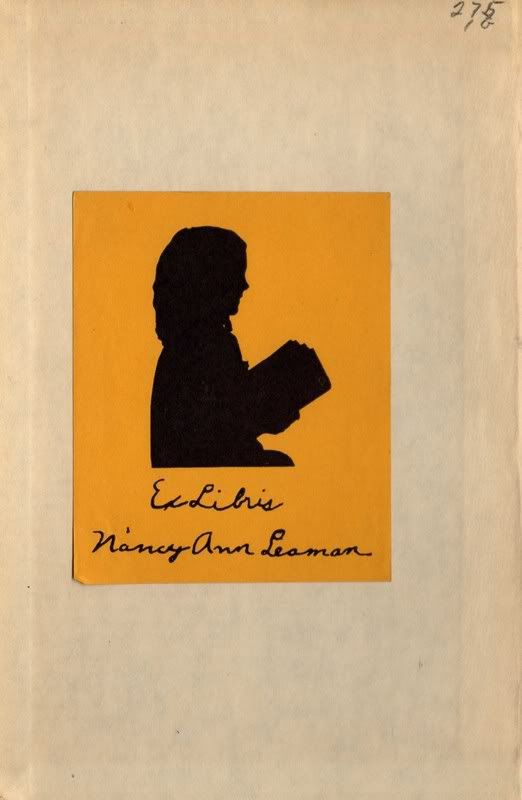
Often the marking of a good book, and a tired one. I was surprised upon looking how few of my books were marked ex libris. Then I noticed how many were missing one of the the end papers. Libraries discard resellers cut off the marked pages to create the appearance of a less used book. What a shame. I'd prefer to know where it's been.


Wednesday, November 07, 2007

Darker Blues

I'm quoting a quote, but they re-use the passage masterfully in a meaningful place. The book is a collection of biographical essays about the musicians of the northern Mississippi. And in context the place matters as much as the people.

"On the fields, in the forests, in the streets and yards and homes and businesses, and barns, the water left a rising muck. It filled the air with stench, and in the sun it lay baking, and cracking like broken pottery, dung-colored and unvarying to the horizon..."

-Originally from Rising Tide, by John Barry.

Saturday, October 27, 2007

By Grand Central Station I Sat Down and Wept

Elizabeth Smart wrote the most overtly dramatic book I've ever read, and most of it for all of it's bloated melodrama was also a work of evocative poetic-prose. The book is epic. Most of it is senseless out of context. But the book was autobiographical, and like real life, had a sequel: The assumption of the Rogues and Rascals. They're often sold bound together as they pertain to the same characters and plot lines of the authors life.

"Once upon a time there was a woman who was just like all women. And she married a man who was just like all men. And they had children who were just like all children. And it rained all day."

You can smell the dissatisfaction. After By Grand Central Station I Sat Down and Wept, it's as if she learned craft to companion the intensity of her expression. Much of the book is still burdened with extreme melodrama, but the prose is still in it's own league. I'll quopte a tad more:

"Sometimes with slow understanding they make imperceptible movement towards each other, perectly balanced on their twig; their eyes outward, their snouts upwards, their tails curled permanently like teacup handles."

Sunday, September 30, 2007

Smokestack Lightning

The book Smokestack Lightning is about barbecue and the gnarled fingers of elderly black men smoking cow heads and brisket in hand-dug smoke pits in the yards behind abandoned gas stations in the South. More than that of course... It is not a cookbook it's as much about the American Dream as Fear & Loathing was. The concepts are surprisingly vast in a biopic that's more often a comic foil in the middle of a morning tv show. Lolis Eric Elie makes it all artful, tangible and powerful. It courts the real for the greater sense of palpation.

"Truth being what it is-vast and yet surprisingly deceptive-what you will retain will be the tale's edited version, it's essence. And as you choose to remember then, both tale and teller, Charlie mac will become more than a historian of a small village in Georgia. He will become the griot of this whole thing-its Homer if you will."
-Lolis Eric Elie

There's a great interview with the author here. I also hear his book cornbread nation is excellent but I've not read it yet. Lolis Eric Elie is a columnist and food writer for the New Orleans Times-Picayune.

Monday, September 24, 2007

Personification

The book Kleinzeit, by Russell Hoban is not very readable, and is far inferior to his more faous book Ridley Walker. But it has more personification than I've seen any any other text. Buildings are live, colors, god and death are both living breathing and seemingly mortal characters... yet he describes them so aptly in their "human" trappings.

last paragraph chapter 8:
"Hospital said nothing, had no quips and cranks and wanton wiles. Hispital huge, bigger than any sky, grey-faced, stony faced in the rough clothes of the prison, the madhouse, Tom o'Bedlam. hospital waiting, treading its bedlam round in thick boots. Hospital mute, gigantic, with thick empty hands."

Saturday, September 08, 2007

Oswald de Andrade

I cut out the paragraph and stuck it in my pocket. I found it today, years later in a book. I remembered I read it on a plane and assumed it was an in-flight magazine. I was wrong. It was Wired. The article was by Julian Dibbell, but she's quoting the modernist Brazilian poet Oswald de Andrade.


"In 1556, not long after the Portuguese first set foot in Brazil, the Bishop Pero Fernandes Sardinha was shipwrecked on its shores and set about introducing the gospel of Christ to the native "heathens." The locals, impressed with the glorious civilization the bishop represented and eager to absorb it in its totality, promptly ate him. Thus was born Brazilian culture."
-Oswald de Andrade


Full text Here.

Monday, September 03, 2007

James Parker, Boston Phoenix

James Parker is writer for the Boston Phoenix and is clearly wasting his skills on a weekly periodical instead of somthing more timeless like a book. The strong language, and the broad vocabulary, both say Nick Tosches but the brute masculinity and the heavy use of punctuation says Fulkner. Truly a surprise find last week.

"In ethnographic terms, the bouncer is the big daddy of the liminal realm, the place of thresholds, through which participants in the rite are conducted—moved along, if you like—as they pass from one state to another. Jittery clubbers at the door, agitating for entry; the gyre of and out-of-control pit, slewing toward carnage; a drugged or boozed patron sprouting invisible tusks of hostility; the bouncer is there, filling the space negotiating the transition."
-Bouncer Lit

Love the combination of words: Ethnographic, Liminal and Big Daddy in the same sentence. Gyre, slewing and "tusks of hostility" all need a good dictionary and together manufacture a dense and powerful image. Somone give the man a book deal please.

His articles here: http://thephoenix.com/Author.aspx?name=JAMES%20PARKER